spektr 3.0 is live
Try the platform

Share the article
spektr 3.0 adds three products to the platform: Policy Engine, Transaction Monitoring and Case AI. Onboarding, monitoring and resolution on one system, governed by your own policies.
Wondering why Mikkel is in uniform? Click here to find out.
Regulation is complex. Launching within it shouldn't be.
Every regulated company builds systems to stay in control. But after enough time and growth, those same systems can become the thing slowing you down. More customers, products, markets, cases and alerts. And more people to keep it all running.
The way the compliance market has been historically built has exacerbated this. Onboarding providers on one side, transaction monitoring specialists on the other, and what you need to make a call ends up in different systems, different documents and different people's heads.
This has meant that whether it's a new product, a new market or a new initiative, launching becomes a negotiation between speed and control: Product slows down, Operations watches the backlog grow, and Compliance gets asked to approve what it can't see.
Mission control for all three teams
With spektr 3.0, Product moves faster, because the checks that used to be meetings are now built into the process. Operations scales without adding headcount, because the repeatable work stops being manual. Compliance stays in control, because every action, approval and piece of evidence lands in one traceable record it can defend.
Policy Engine: your policies, structurally enforced
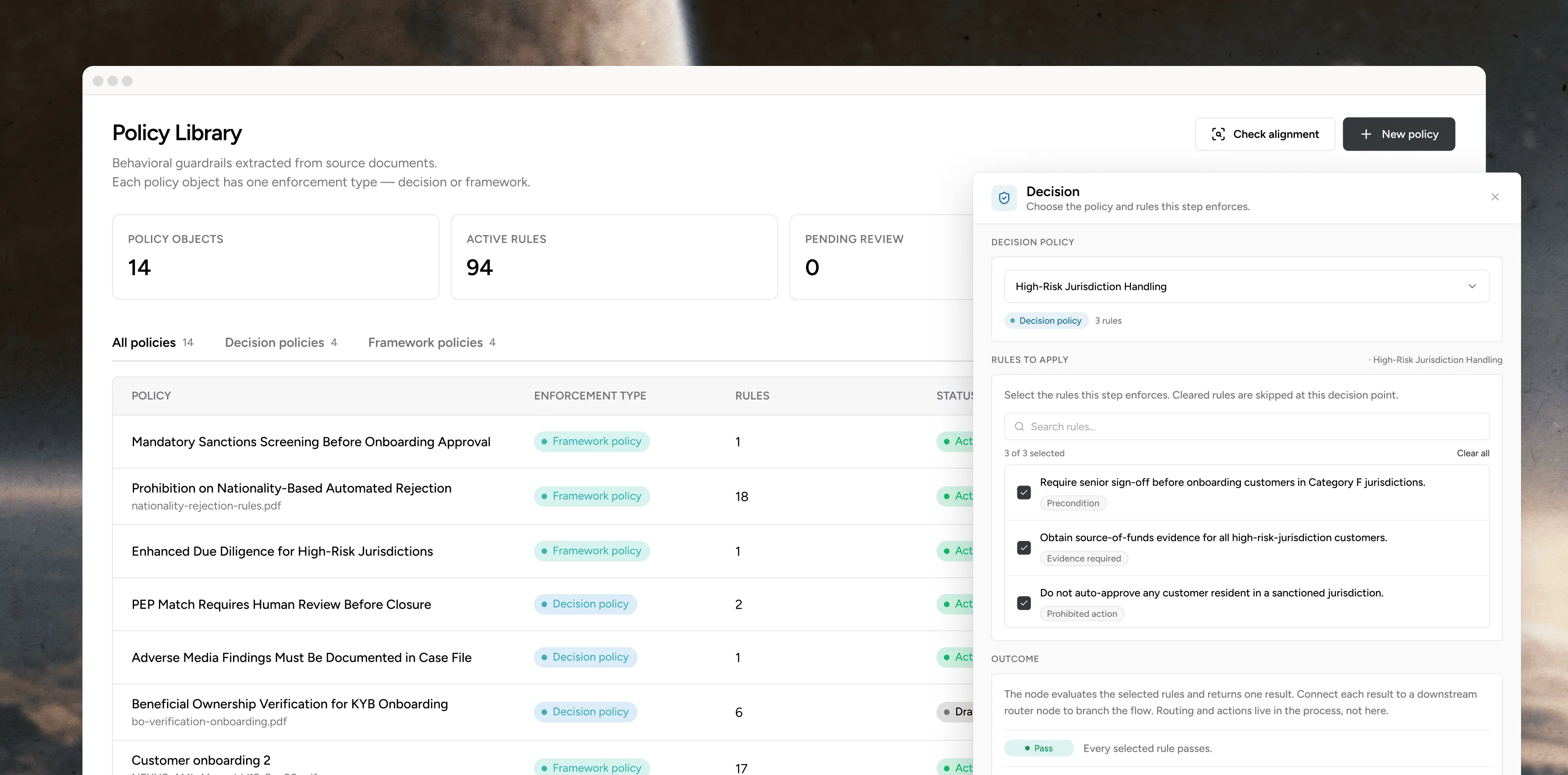
Policy Engine turns your policies into rules your team approves, and every process and every agent on the platform has to align with them.
Upload your policy documents or write them in the platform. Our AI extracts the individual rules; your compliance team approves, edits or rejects every single one before it takes effect. spektr doesn't write your policy and never owns it. The AI proposes, a person decides. Changes are versioned, and once approved, the rules govern everything downstream: workflows and agents are checked against them before they go live, and decisions are evaluated against them during casework. When Compliance asks whether a change is within framework, the system answers, with evidence.
Transaction Monitoring: onboarding to monitoring, one platform
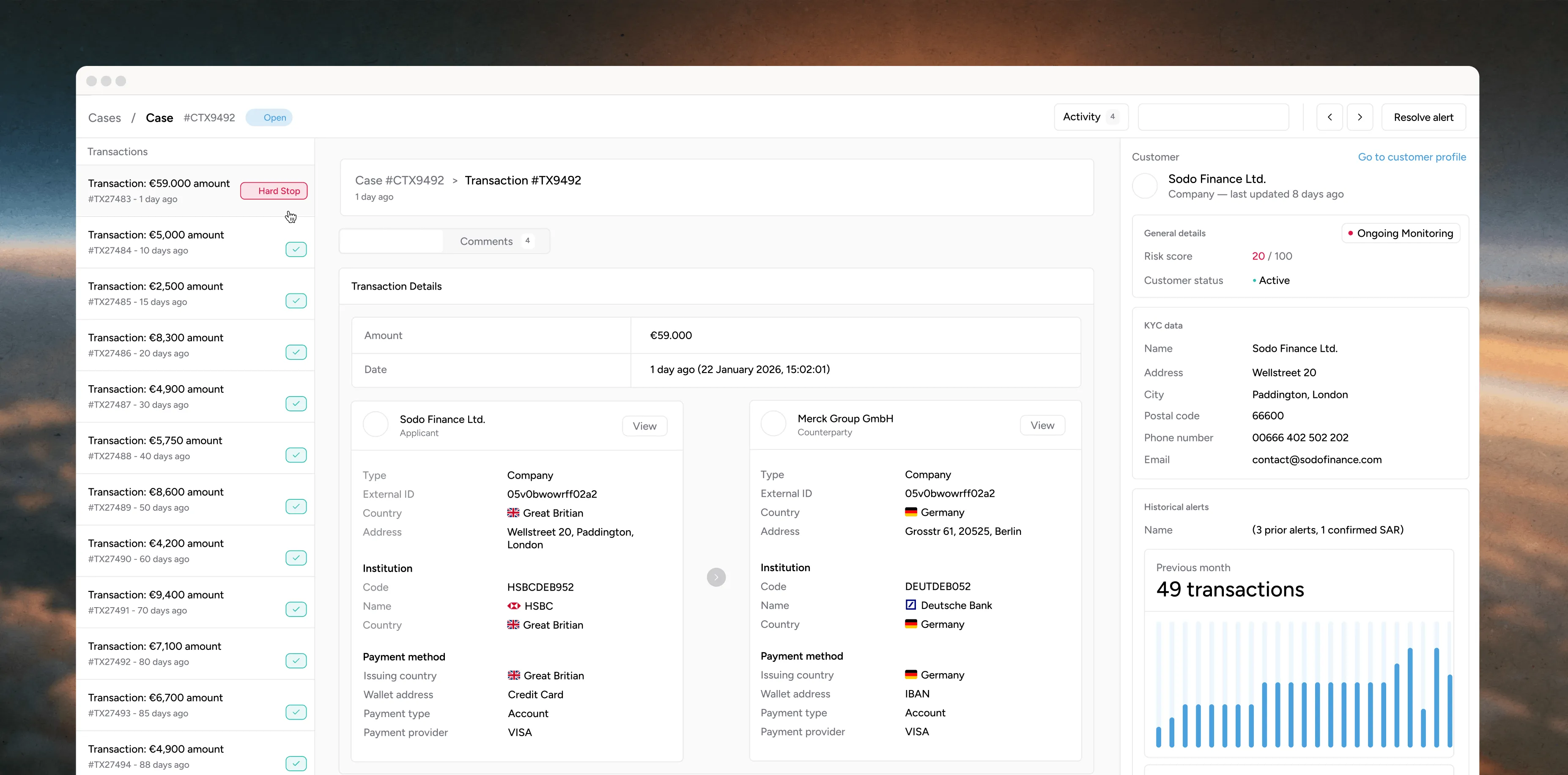
Transaction Monitoring puts onboarding and monitoring on one platform, and every alert traces back to a named rule.
Your team builds detection rules in a visual builder, without an engineering queue: velocity checks, thresholds, multi-leg patterns. Activity is checked in real time, retrospectively, or on a schedule, all from the same engine, and it can block a transaction before completion or open a case automatically with the relevant transactions attached. Detection is deterministic by design, so every alert records which rule fired, which values breached it and which transactions contributed. When a regulator or a model validation team asks why an alert exists, that record is the answer.
Because onboarding and monitoring are the same system, findings travel in both directions. An alert or a case outcome updates that customer's risk profile automatically, and what you learned at onboarding sits inside your rules: risk level, tenure, segment. Monitoring can see who it's looking at.
Case AI: agents on the case work
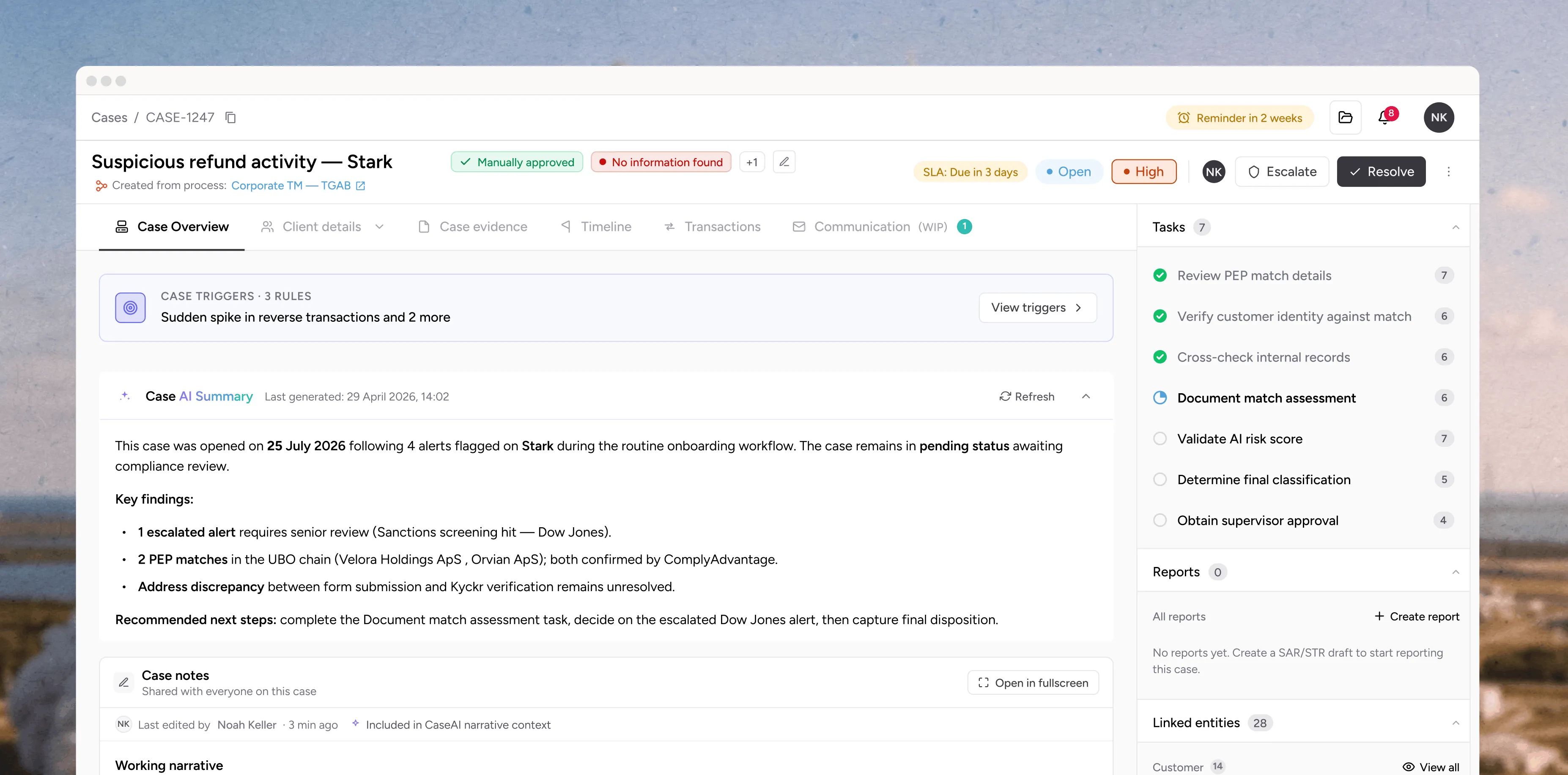
Case AI puts agents on the case work, the biggest manual workload most compliance teams carry. The hours there don't go into the decision, they go into the legwork before it. That's the part the agents absorb, and it's what brings average handling time down.
Sanctions, PEP and adverse-media reviews, alert triage, periodic reviews: agents review the evidence, gather missing details, clear what the evidence supports clearing and recommend a resolution. Every task returns a structured verdict: an answer, a confidence level, a recommended disposition and citations to the evidence used.
Agents gather that evidence through an allow-list of vendor sources your institution approves: Dun & Bradstreet, ComplyAdvantage, Kyckr, OpenCorporates and others. Free-form web scraping is off by default. The reasoning is AI, the evidence comes from sources you've already signed off on.
The agents investigate and recommend. A person always signs off.
spektr 3.0 is now live.
You shouldn't have to choose between speed and control.