The Complete Guide to Compliance in Sweden
Try the platform

Share the article
When compliance professionals discuss Nordic digital infrastructure, Sweden is often referenced as a practical example. The country's BankID system has achieved widespread adoption and provides a functional digital identity solution used across many sectors. For organizations building compliance operations in Scandinavia or across Europe, Sweden represents one of the more straightforward environments to work with – a nice break from a landscape often characterized by complexity and fragmentation.
Sweden's compliance ecosystem reflects the country's pragmatic approach to digitization: build systems that work reliably for their core purposes, maintain consistent data quality, and create straightforward access for legitimate users. This isn't about novel innovation or experimental technology. It's about functional infrastructure that enables efficient business operations while maintaining appropriate transparency and oversight.
The Foundation: Swedish BankID
Swedish BankID is widely used for electronic identity in Sweden, used by millions of people regularly for user authentication and digital signatures. In 2023, BankID was used 7.1 billion times and had 8.5 million unique users – representing most of Sweden's adult population. This level of adoption creates a different compliance environment compared to markets where digital identity remains fragmented or has limited coverage.
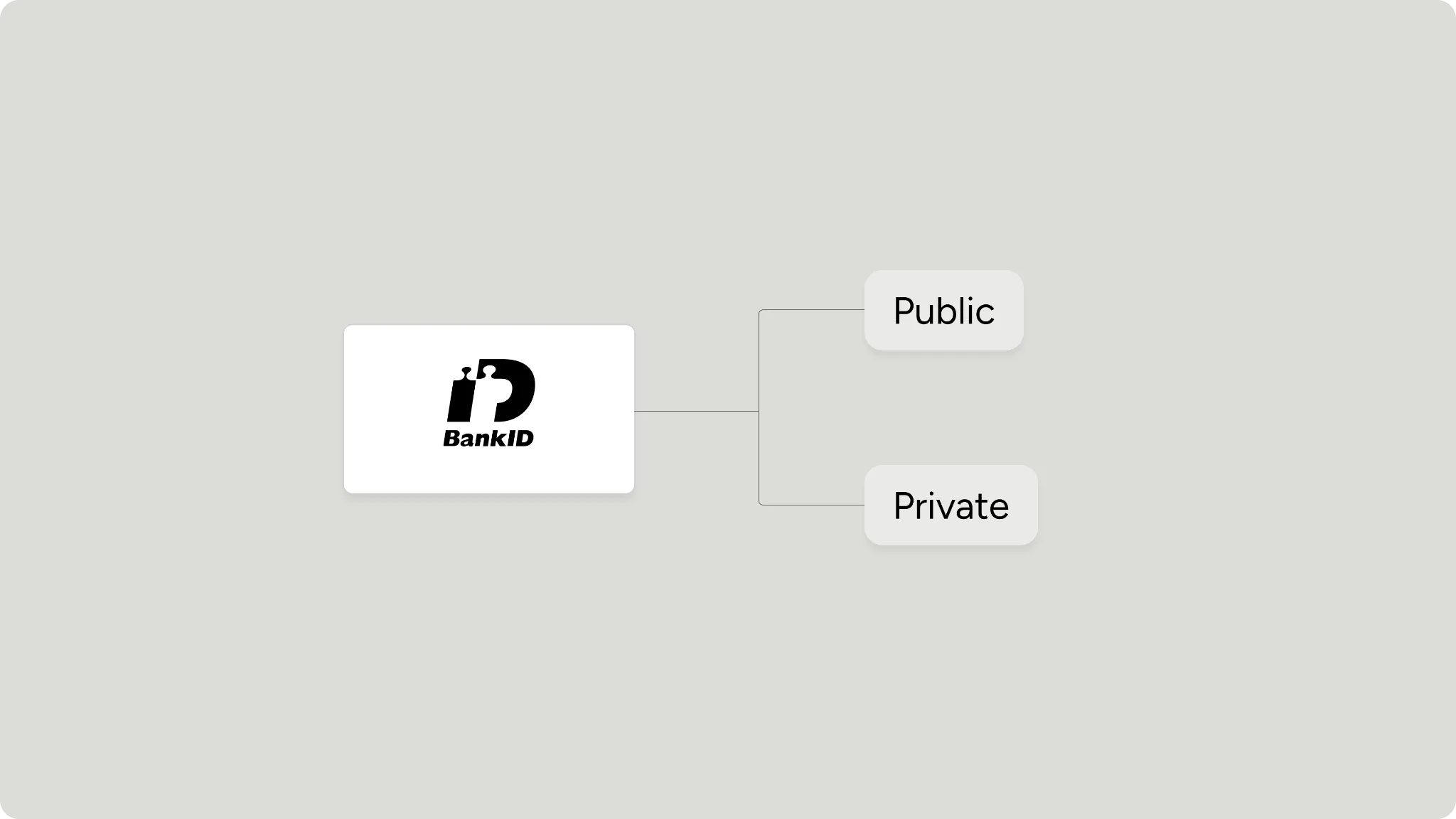
How BankID Works
BankID was first introduced by Finansiell ID-Teknik BID AB in 2003 and is developed, owned, and run by seven Swedish banks: Svenska Handelsbanken, Swedbank, SEB, Nordea, Danske Bank, Länsförsäkringar, and Sparbanken. This bank consortium model provides centralized governance while distributing issuance and liability across multiple institutions.
For end users, obtaining BankID is straightforward. Anyone with a Swedish personal identity number (personnummer) and an account at one of the participating banks can get BankID. The onboarding process includes either in-person or digital verification, which is required under Sweden's anti-money laundering (AML) and know-your-customer (KYC) regulations. Once issued, the BankID can be used across countless services – government portals, private sector platforms, financial services, healthcare systems, and commercial transactions.
Mobile BankID is the most commonly used type due to its accessibility and user experience. When verifying their identity via mobile BankID, users can use a personal code or biometrics (Face-ID or fingerprint). The mobile-first approach has contributed to BankID's adoption, aligning with how people use technology rather than requiring desktop computers or specialized hardware.
Security Enhancements: Secure Start
From May 1, 2024, the so-called "secure start" became mandatory for BankID login and authentication. This security enhancement addresses a specific phishing vulnerability where attackers could trick users into authenticating fraudulent transactions initiated remotely.
Secure Start introduces two key mechanisms. For same-device authentication (when someone logs into a service on their phone using BankID on the same phone) the BankID app is launched directly without intermediate steps on the device where the login occurs through "auto-start". This ensures the person starting the authentication process is the same person completing it.
For cross-device authentication (like logging into a desktop website using mobile BankID) the person must use the BankID app to scan an animated QR code on that device's screen, which adds an extra layer of security by ensuring that it's the same person who initiates the BankID verification process and scans the QR code. The animated nature of the QR code prevents screenshot-based attacks.
Most significantly, the option to initiate authentication with a personal identification number (personnummer) has been removed, as this had been an easy way for scammers to activate a user's BankID service during a phone call.
BankID for Compliance
For compliance purposes, BankID provides several useful capabilities. Authentication involves biometric approval or a six-digit code that users receive through the BankID app, and the system meets Sweden's Financial Supervisory Authority requirements while enabling Advanced Electronic Signatures (AES), which complies with the EU's eIDAS regulation. This means documents signed with BankID have legal validity across the EU.
For customer onboarding, BankID enables streamlined verification processes. BankIDs are used to verify a customer's identity during the onboarding process, which complies with the country's KYC and AML regulations without requiring paper documents or in-person visits. This has enabled digital onboarding flows that meet regulatory requirements while providing functional user experience.
The system also provides reliable identity data. When someone authenticates with BankID, you receive their personnummer and verified name—data you can trust because it comes from the banks that originally verified the individual's identity through rigorous processes.
Digital ID Card
BankID launched a digital ID card in 2023 that serves a similar function and contains the same information and portrait photo as physical ID documents. Users can show the digital ID while buying alcohol and other goods that require age verification as well as collecting parcels at the post office. This extends BankID's utility beyond pure digital contexts into physical verification scenarios, though it doesn't replace traditional identification for travel or certain government interactions.
Business Registry: Bolagsverket
Sweden's business registry infrastructure centers on Bolagsverket, the Swedish Companies Registration Office. Bolagsverket is a Swedish government agency which mainly handles the registration of new companies and registry changes for existing businesses, such as change of address and change of board of directors and auditors. The Agency receives financial statements and records of chattel mortgages and liquidations.
Bolagsverket maintains comprehensive information on Swedish companies, including private limited companies (aktiebolag), public limited companies, partnerships, sole proprietorships, cooperatives, associations, and foundations. The registry dates back over a century, though full computerization came later, with electronic access becoming standard in the 2000s.
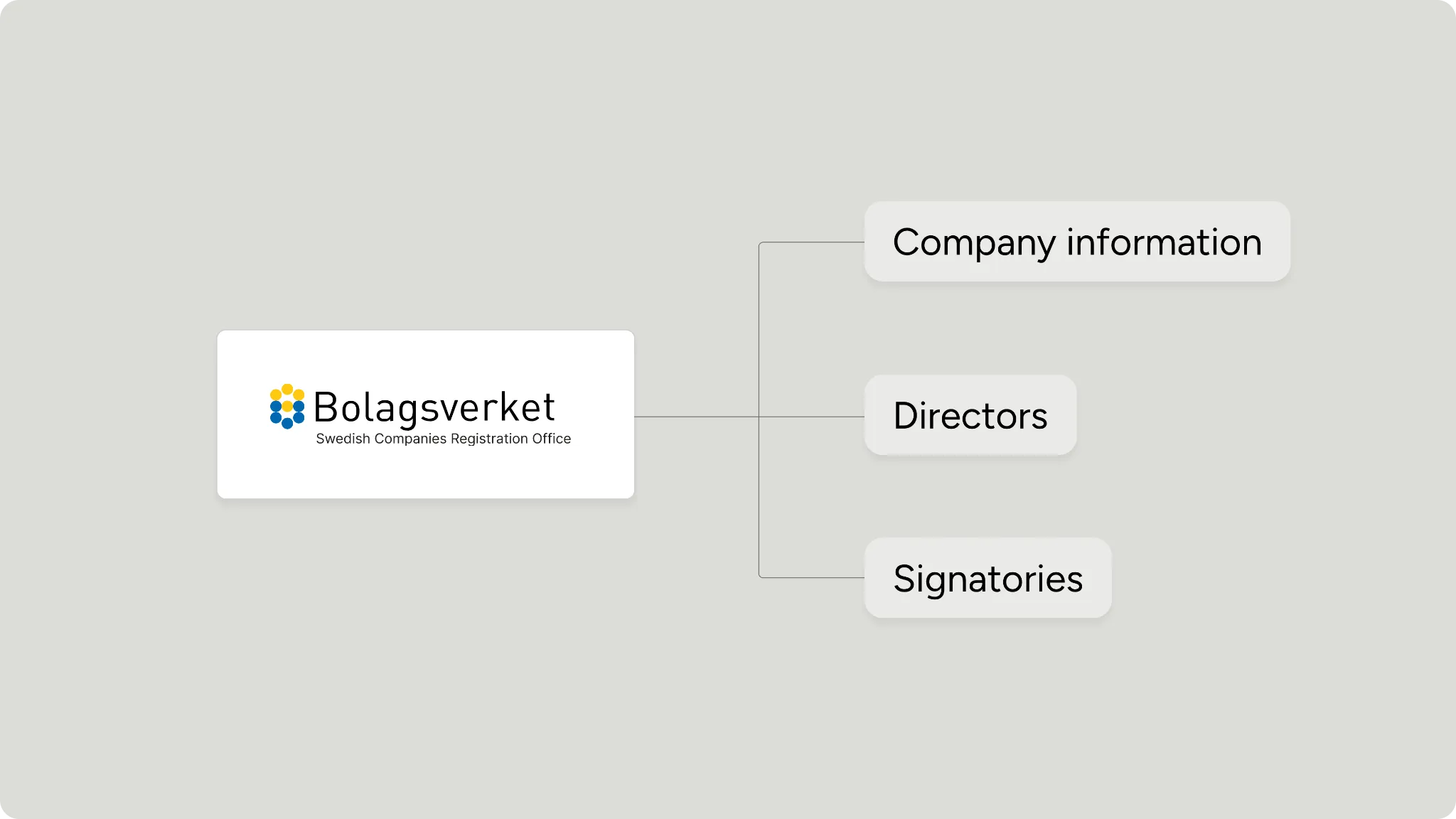
Accessing Company Information
Sweden has a public registry available and does not require any kind of subscription or paid plan to access basic information. This open access model makes initial company verification straightforward and cost-effective.
Through Bolagsverket's online services, you can search for companies using their organization number (organisationsnummer) or company name. Basic search results provide immediate access to fundamental company details: registered name, organization number, registered address, legal form, registration date, and current status.
For more detailed information, Bolagsverket offers registration certificates (registreringsbevis) that can be purchased in Swedish or English. These certificates contain up-to-date information about a company registered in Sweden, including name, address, founding date, key management, registered capital, and authorized signatories. These official extracts serve as authoritative documentation for due diligence purposes.
Financial statements are also accessible through Bolagsverket, though the Income Statement is not normally present, as many companies are exempt from drafting and/or filing. This reflects Swedish regulations that provide exemptions for smaller companies, which compliance teams should be aware of when assessing companies that might not have complete financial disclosures.
Data Quality and Timeliness
Bolagsverket maintains data quality through regular updates as companies file changes. The registry contains current information based on company filings and Bolagsverket's processing cycles. When directors are appointed or removed, when addresses change, when ownership structures are modified – these updates flow through to the registry.
The centralized nature of the Swedish system means you're not navigating multiple local registries or dealing with significant regional variations. Bolagsverket handles all Swedish companies regardless of location within Sweden, providing consistent data structures and access methods nationwide.
The Beneficial Ownership Situation
Sweden's compliance landscape shows a gap between policy and practical access regarding beneficial ownership data. The majority of Swedish companies, associations and legal entities must register beneficial ownership information with Bolagsverket, and newly registered companies and associations must register beneficial ownership information within four weeks from their registration date.
Sweden implemented these requirements on August 1, 2017, which was implementation of the Fourth EU Anti-Money Laundering Directive in Swedish law. The requirements apply broadly to limited companies, partnerships, cooperatives, foundations, associations, and certain foreign entities operating in Sweden. Generally, a UBO is anyone who owns or controls at least 25% of the company, either through direct ownership of shares or indirect influence, aligning with EU standards.
The Access Challenge
The beneficial ownership information exists in Bolagsverket's systems – that's not the issue. The challenge is how to access it efficiently for compliance purposes. The API access for UBO data has been running on outdated infrastructure and has been phased out, with plans to make UBO data available again through an API next year. This creates a temporary but significant gap in automated access.
Unlike company registration data, which is freely searchable online, beneficial ownership information requires specific access justifications and mechanisms. This reflects EU data protection requirements and the balance between transparency for legitimate purposes and privacy protection for individuals.
For compliance teams conducting beneficial ownership verification, this means working with alternative approaches during the transition period. The information is registered and maintained, but accessing it programmatically at scale faces technical limitations during the infrastructure modernization.
Bridging the Gap: UC and Alternative Data Sources
This is where Sweden's pragmatic ecosystem provides alternatives. UC (Upplysningscentralen) is Sweden's leading business and credit reference agency, operating since 1977. UC gathers and processes information to be used by companies and private individuals.
UC provides comprehensive business information that goes beyond what's in Bolagsverket alone. UC sources include the Swedish Companies Act, Swedish Companies Registration Office (Bolagsverket), Swedish Tax Agency (Skatteverket), Statistics Sweden (SCB), and has a unique credit register with different types of given loans as well as information on misused bank accounts.
Importantly for the current situation, UC can provide ownership information as part of their business reports. While waiting for Bolagsverket's new UBO API to become available, compliance teams can use UC as an alternative source for ownership verification. Commercial data providers don't replace official registry access, but UC's data is widely used and trusted in the Swedish market.
UC offers various integration options, from individual report purchases to API access for high-volume users. For organizations already using UC for credit assessment and financial verification, adding ownership data through the same provider creates operational efficiency.
Credit Information and Financial Assessment
Beyond ownership data, UC plays a significant role in Swedish compliance operations through credit and financial information. UC's Corporate Reports allow you to check a customer's creditworthiness and ability to pay, providing data for granting credit to creditworthy customers and requesting advance payment or other payment terms for customers carrying a high risk.
This financial context is valuable for risk-based compliance approaches. A company's payment history, credit utilization, any payment remarks or enforcement actions—these factors contribute to overall risk assessment beyond just entity verification and ownership structure.
For consumer-facing businesses, UC also provides personal credit reports that enable verification and risk assessment of individuals, though these must be used in accordance with Sweden's Credit Information Act, which requires legitimate need for accessing personal credit data.
The integration of registry data, financial information, and credit history creates a relatively comprehensive picture of Swedish entities and individuals. Compliance teams can access official registry confirmation from Bolagsverket, financial and credit context from UC, and identity verification through BankID – covering the key verification pillars efficiently.
Language Considerations
Swedish compliance operations benefit from a straightforward language situation. All official documents and registry information are in Swedish, which is expected. Unlike some markets where multilingual complexity creates challenges, Sweden's linguistic consistency makes automation more straightforward.
That said, Swedish language understanding remains important for effective automation. Company names, legal forms (aktiebolag vs. publikt aktiebolag), addresses, and business descriptions all appear in Swedish. Certificates of registration are available in Swedish or English, which helps for international users, but most data processing requires handling Swedish text.
For automated screening – sanctions lists, PEP databases, adverse media – systems need to handle Swedish characters (å, ä, ö), Swedish naming conventions, and Swedish legal terminology. Swedish is well-supported by modern natural language processing systems, and the linguistic complexity is manageable compared to markets with multiple official languages or more complex character sets.
Cross-Border Compliance in the Nordic Context
Most compliance operations touching Sweden also involve other Nordic countries. The similarities and differences across the region create both opportunities and challenges.
All Nordic countries have strong digital identity systems, but they're not interoperable by default. BankID works in Sweden, but Norwegian BankID is a separate system, as is Danish MitID and the Finnish Trust Network. Each requires separate integration, though the conceptual approach is similar across all of them.
For registry data, each Nordic country maintains its own company registry with different access methods and data formats. Sweden's Bolagsverket, Norway's Brønnøysundregistrene, Denmark's Erhvervsstyrelsen, and Finland's PRH all serve similar functions but with distinct implementations.
The practical implication: Nordic compliance operations require jurisdiction-specific integrations while maintaining consistent compliance logic across countries. Data quality tends to be high across the region, and access is generally straightforward compared to many other European markets.
The Automation Opportunity in Sweden
Sweden's compliance infrastructure provides a solid foundation for automation. The widespread adoption of BankID means identity verification can be fully automated with high coverage of the Swedish population. Bolagsverket's accessible registry data enables automated company verification. UC's API access allows integration of financial and ownership information into automated workflows.
The temporary gap in direct UBO API access from Bolagsverket doesn't prevent automation, it just shifts which data sources you use during the transition period. Organizations can build automated workflows using UC for ownership verification now, with the flexibility to switch to Bolagsverket's API once it becomes available. This pragmatic approach maintains automation capabilities while registry infrastructure modernizes.
Several automation opportunities are particularly relevant for Swedish compliance:
Automated identity verification: BankID integration enables fully digital onboarding without manual document review. When customers authenticate with BankID, you receive verified identity data that meets regulatory requirements. This streamlines customer onboarding while maintaining compliance standards.
Real-time company verification: Automated systems can query Bolagsverket for company information, pulling registration details, management structure, and authorized signatories. This verification happens in seconds rather than requiring manual registry searches.
Financial risk assessment: Integration with UC enables automated credit checks and financial assessment as part of onboarding or ongoing monitoring. Payment history, credit ratings, and financial indicators can be automatically evaluated against risk thresholds.
Ownership verification: During the UBO API transition, automated systems can request ownership information from UC, extracting structured data for compliance purposes. Once Bolagsverket's new API launches, the same automation logic can be redirected to the official registry source.
Document extraction: Swedish registry documents and certificates contain structured information that automated systems can extract and normalize. Rather than compliance officers manually reading through Swedish-language documents, extraction systems can identify key data points automatically.
Continuous monitoring: Automated systems can monitor Swedish companies for registry changes, financial developments, or other relevant updates. When monitored entities change directors, addresses, or face financial difficulties, compliance teams receive automatic alerts.
The key to effective automation in Sweden is combining reliable data sources with appropriate processing logic. BankID provides trustworthy identity verification, Bolagsverket offers authoritative company data, and UC supplies financial and ownership context. Automated systems can integrate these sources to create comprehensive compliance workflows.
Best Practices for Swedish Compliance Operations
Based on the realities of Sweden's compliance landscape, several practices help organizations build efficient Swedish compliance operations:
Implement BankID authentication: BankID's high adoption rate makes it a practical choice for identity verification in Sweden. Supporting BankID authentication enables digital onboarding that meets regulatory requirements while providing good user experience. Most Swedish users are familiar with BankID and expect to use it for verification purposes.
Use Bolagsverket for company verification: Direct access to official registry data should be the foundation of company verification. Pull registration certificates for due diligence documentation, verify management and signatory information from official sources rather than customer-provided documents, and maintain records of when company data was verified and from which sources.
Consider UC for comprehensive business intelligence: UC provides valuable context beyond basic registry information. Financial assessment, credit history, payment patterns, and ownership data create a fuller picture of business relationships. For organizations conducting ongoing business relationships, UC reports provide monitoring capabilities that complement registry verification.
Plan for the UBO transition: During the current transition period, establish clear processes for ownership verification. Document which data sources you use for beneficial ownership information, maintain procedures for when Bolagsverket's new API becomes available, and ensure your systems can adapt to the changing data source without disrupting compliance workflows.
Maintain consistent standards across Nordic markets: If operating across multiple Nordic countries, keep compliance standards uniform even though data sources differ. Define risk thresholds that apply regardless of which country's registries you're accessing, specify documentation requirements independent of specific registry implementations, and implement risk assessment logic that evaluates all entities consistently.
Handle Swedish language appropriately: Automated systems need genuine Swedish language processing capability. Ensure company name screening handles Swedish characters correctly, document extraction understands Swedish legal terminology and formats, and adverse media screening can work with Swedish-language sources.
Document your data sources and timing: Swedish compliance involves multiple data providers. Maintain clear documentation of which data points come from which sources, when information was last verified or updated, and what the intended purpose and legal basis is for accessing the data. This documentation is important for data protection compliance and audit purposes.
Build monitoring into workflows: Swedish registry and financial data updates regularly, making continuous monitoring practical. Rather than annual re-verification of Swedish entities, implement automated monitoring that alerts to relevant changes such as management updates, address changes, financial statement filings, or payment remarks.
Future Developments: The New UBO API
The planned launch of Bolagsverket's new UBO API represents a significant development for Swedish compliance automation. Moving from the phased-out legacy system to modern API infrastructure should improve both access reliability and integration possibilities.
While specific technical details and exact launch timing may evolve, the direction is clear: Sweden is investing in making beneficial ownership data accessible through modern technical interfaces. This aligns with broader EU efforts to improve beneficial ownership transparency while respecting data protection requirements.
For organizations building Swedish compliance operations, this transition requires adaptable systems. Current workflows might use UC for ownership verification, but should be built with the flexibility to incorporate direct Bolagsverket API access once available. The compliance logic (what ownership information you need, what thresholds trigger additional review, what documentation you maintain) remains consistent regardless of which technical source provides the data.
The key is avoiding systems that are rigidly tied to specific data sources. Build workflows that can accommodate changing data providers while maintaining consistent compliance standards. This adaptability serves not just the Swedish UBO transition, but any future registry modernization or data source changes across jurisdictions.
How spektr Enables Efficient Swedish Compliance
At spektr, we've built our compliance automation platform to work effectively across European jurisdictions, including Sweden's particular combination of strong digital identity, transparent registry access, and evolving ownership data infrastructure.
For Swedish compliance specifically, we provide:
BankID integration for identity verification: Our platform integrates with Swedish BankID, supporting secure start and modern authentication flows. Your Swedish customers can verify their identity using the authentication method they already use daily, and you maintain streamlined onboarding workflows that meet regulatory requirements.
Automated Bolagsverket verification: We connect directly to Bolagsverket for company information, pulling registration data in real-time and accessing official certificates. Company verification happens automatically with structured data extraction from Swedish registry documents.
UC integration for comprehensive business intelligence: We integrate with UC to access financial data, credit information, and ownership details. During the current UBO transition period, UC provides reliable ownership verification. We also leverage UC's financial data for risk assessment and ongoing monitoring.
Adaptable ownership verification: Our systems are built to accommodate changing data sources. We currently use UC for ownership information where needed, but our architecture allows seamless transition to Bolagsverket's new UBO API once it becomes available. Your compliance workflows remain consistent even as underlying data sources evolve.
Swedish language processing: Our AI systems understand Swedish language and legal terminology. They can extract information from Swedish documents, conduct adverse media screening in Swedish, and handle Swedish entity names correctly, including proper handling of Swedish characters and legal forms.
Unified Nordic workflows: When you're verifying entities across Sweden, Norway, Denmark, Finland, or other European markets, spektr provides consistent interface and workflow. You maintain the same compliance standards and process efficiency regardless of which jurisdictions you're operating in.
Continuous monitoring: For Swedish entities, we provide automated monitoring of registry changes, financial developments, and other relevant updates. When monitored companies change management, face financial difficulties, or trigger other risk indicators, your compliance team receives automatic alerts.
Normalized data formats: We transform Swedish registry and financial data into standardized formats consistent with data from other jurisdictions, making it easier to apply uniform risk assessment logic and generate consistent reporting across your entire customer base.
Our goal is to let you focus on compliance decisions and risk assessment while we handle the technical complexity of accessing BankID authentication, querying Bolagsverket and UC, processing Swedish-language documents, and managing transitions like the evolving UBO data landscape. Sweden's reliable infrastructure becomes an advantage for efficient operations, and you can maintain consistent compliance processes even when working across multiple markets.
If you're looking to optimize your Swedish compliance operations or build efficient Nordic workflows, we'd be happy to discuss how spektr can help. Reach out to learn more about our approach to compliance automation and how we're helping teams streamline verification across European markets.